
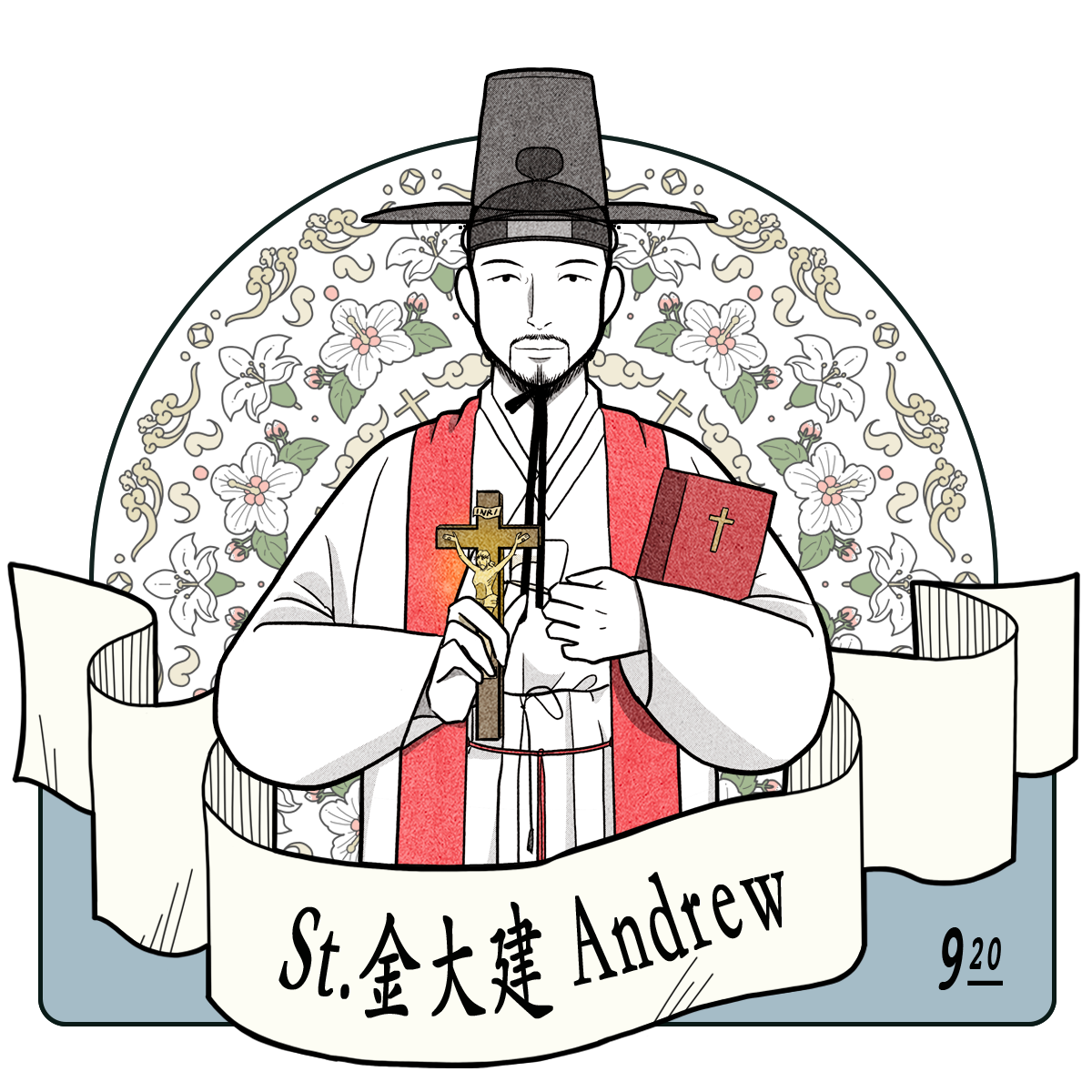
St. Andrew Kim Taegon, Priest, and Companion Martyrs
Feast: Feast Day — September 20 The first priest of the Korean Church,a pioneer of courage.
Descendant of Martyrs, First Priest of Joseon
St. Andrew Kim Taegon was born in 1821 in Solmoe, Dangjin, Chungcheongnam-do. At the time of his birth, his family had already carried the faith for four generations as a fervently Catholic household. His great-grandfather, Blessed Kim Jinhu Pius, was martyred in the Haemi prison; later, his father St. Kim Jejun Ignatius also bore witness to the faith through martyrdom. Faith was passed down like bloodline.
Young Kim Taegon, on the recommendation of Father Pierre Maubant, set out for studies in Macau at the age of 15 with two companions. Despite the harrowing journey and the grievous news of the 1839 Gihae Persecution, he continued his theological studies, and on August 17, 1845, he was ordained a priest at Kimgahang Church near Shanghai, with Bishop Ferréol presiding. He was the first priest of the Korean Church.
Once ordained, he returned to Joseon by sea route together with Bishop Ferréol and Father Daveluy. Taking up residence at Dolumulgol in Seoul, he traveled between Minarigol, Mussoemak, and Seobinggo to administer the sacraments, seeking out the faithful as far as Eun-i and Teogol in Yongin, and even distant Icheon in Gyeonggi. During this time, he also drew a map of Joseon ("Chosŏn Chŏndo") to introduce Korea to the missionaries, and left behind many letters. Among them, his record of the martyrs of the Gihae Persecution is the earliest surviving report to this day.
The following summer, he set out on the sea route of Hwanghae-do to open a new entry route for missionaries. Near Baengnyeong Island, after delivering letters and maps to Chinese fishing boats, he was arrested by government troops at Sunwi Island on his way back. He was sent to Seoul, interrogated more than 40 times, and on September 16, 1846, he was beheaded at Saenamteo at the age of 25. It was just one year and one month after his ordination. Even in prison, he continued to proclaim the Gospel, leaving letters of encouragement to wavering believers.
The Companion Martyrs
Father Kim Taegon did not die alone. Through the Gihae Persecution of 1839, the Byeongo Persecution of 1846, and the persecutions before and after, there were 103 martyrs on Joseon soil who laid down their lives to keep the faith. Of these, 92 were laypersons and eleven were clergy. Not a few gave up their lives together — husband and wife, parent and child, brother and sister. The youngest martyr was St. Yu Daecheol Peter, aged 13, and the most passionate lay leader was St. Jeong Hasang Paul, who paved the way for the establishment of the Joseon Diocese. When the persecution intensified, St. Laurent-Joseph-Marius Imbert, the second bishop of the Joseon Diocese, turned himself in following the Gospel teaching that "the good shepherd lays down his life for the sheep," and was martyred at Saenamteo.
On May 6, 1984, during his visit to Korea, St. John Paul II canonized these 103 together at Yeouido Square in Seoul. It was the first canonization held outside Rome, and the most brilliant testimony the Korean Church offered to the universal Church. The phrase "Companion Martyrs" that follows Father Andrew Kim Taegon's name is not a mere qualifier. It is a community of names who shed their blood together — across Joseon's households and villages, between the literate and the illiterate, between Western missionaries and native believers, transcending age and social status.
God will soon give you a shepherd better than I.
So please do not grieve.
Key Timeline
Born in Solmoe, Dangjin, Chungcheongnam-do
Departed for studies in Macau
Ordained priest in Shanghai — first priest of the Korean Church
Returned on the ship Raphael; drifted to Jeju before landing
Martyred at Saenamteo at age 25
Canonized as one of the 103 Korean Martyrs
Statue installed on the outer wall of St. Peter's Basilica
Scroll